
CERC — Environmental Software and Services
CERC news


< Previous12345678910111213141516171819Next >
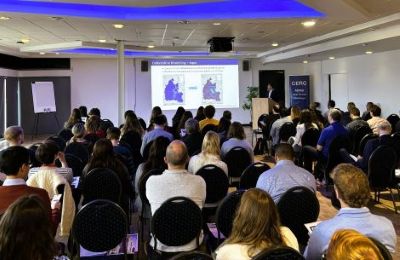
9 Sep 2026Draft agendas now available for the ADMS User Group Meetings, 11-12 November 2026, Manchester
There is still time to book your tickets for the 2026 ADMS User Group Meetings, which will be held at voco Manchester on 11th and 12th November.
- ADMS 6 User Group Meeting, 11th November: view draft agenda
- ADMS-Urban and ADMS-Roads, 12th November: view draft agenda
Tickets are available to order through Eventbrite until 23:30 on Monday 26th October. Organisations with a valid software support contract are entitled to one or more tickets free of charge depending on the type of licence held.
2 Sep 2026A web-tool to estimate the economic cost of air pollution
As part of CERC's work for Impact on Urban Health (IoUH), we have updated our bespoke web-based air pollution impact tool. Although designed for use by the London boroughs of Southwark and Lambeth, an equivalent tool could be useful for a local authority anywhere in the UK.
This update includes the latest pollution data for 2025 as well as the addition of new features.
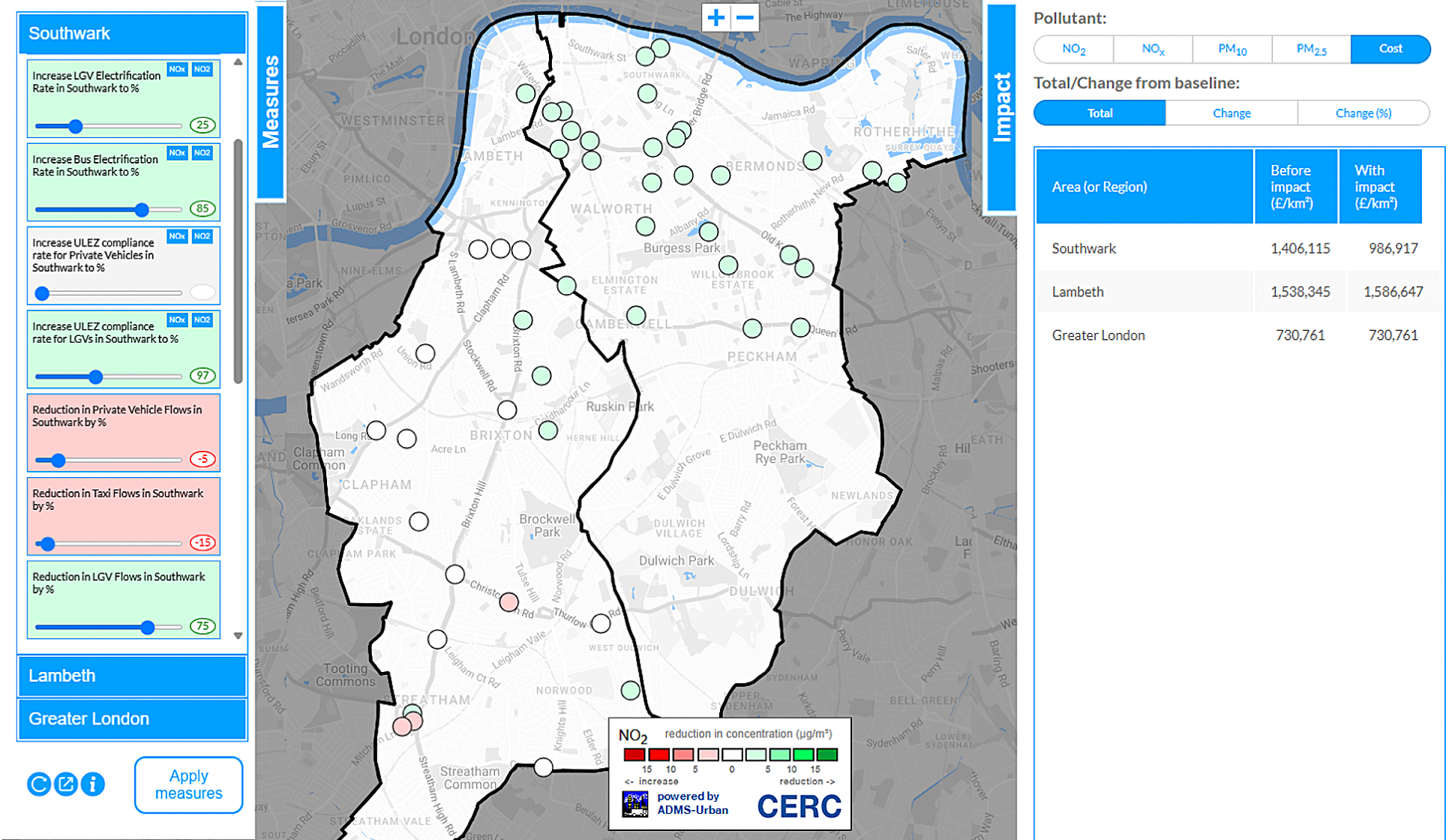
Most interesting is the inclusion of Defra damage costs. This feature calculates the economic cost (£) of air pollution due to the associated health burdens, as demonstrated in the image.
By using the inbuilt 'Measures' sliders, users can visualise the real-world economic benefits of reducing air pollution via a range of schemes, either alone or in combination.
CERC used ADMS-Urban to calculate concentrations of NO2, PM10 and PM2.5 at sensitive locations for 2025. The measures were modelled individually in order to calculate their effectiveness; some example measures are displayed in the image (right click to expand). The tool shows how specific clean air measures reduce pollution.
If you would like access to the web-tool, please email Amandeep Kellay at IoUH, giving the reasons for your interest.
The tool is scalable and would represent a ground-breaking application of health-based science if, for example, applied across the whole of London. If you are interested in our work on the implications of air quality and would like to make use of our expertise, please contact CERC.

18 Aug 2026defra Environmental Science Research, Development and Evidence (ES RDE) Framework
CERC is pleased to announce that we have been appointed to Defra's new Environmental Science Research, Development and Evidence (ES RDE) Framework, as part of a consortium led by Logika Group (the trading name of Air Quality Consultants).
This means that defra and agencies within the defra group (including Environment Agency and Natural England) and the Drinking Water Inspectorate (DWI), Department for Science, Innovation and Technology (now Department for Business, Innovation, Science and Trade (DBIST) and Department for Energy Security and Net Zero (DESNZ) can make a direct award to CERC or other consortium members, or invite AQC to bid in a mini competition drawing on consortium members with relevant expertise.
Under the previous RDE Framework, CERC contributed to 11 projects for defra, Department for Transport (DfT) and the Environment Agency. The new Framework started earlier this year and will run until the end of January 2034.
CERC has been awarded places on four sublots within Lot 3, Air Quality and Sound:
- Sublot 3.1: Air Quality Analysis and Expert Services
- Sublot 3.3: Air Quality monitoring and data projects
- Sublot 3.4: Modelling tools for Air Quality studies
- Sublot 3.5: Air Quality economics and social research
The consortium also includes the following organisations:
- Aether Ltd
- UK Centre for Ecology and Hydrology (UKCEH)
- EMRC/Mike Holland
- I C Consultants
- Institute of Occupational Medicine
- Ipsos
- Risk & Policy Analysts (RPA) Ltd
- Rothamsted Research
Please contact us to find out how the consortium can support you.
16 Jul 2026New indoor-outdoor air quality modelling projects
CERC are very pleased to be part of the team awarded funding for a feasibility project looking at the influence of outdoor air quality on indoor exposures, and associated health outcomes. The project 'INdoor Health, Air pollution and Location-linked Exposure in the West Midlands' (INHALE-WM) will investigate how the location, structure and quality of domestic buildings shape residents' exposure to traffic-related air pollution in social housing. The study has been funded as part of the BREATHE IN EPSRC Micro Network +, which is addressing the relationship between population health and the built environment.
Dr Nana Wei at the University of Birmingham leads the team, bringing together expertise from CERC alongside researchers from the University of Reading, as well as Birmingham colleagues from the Department of Applied Health Sciences and the School of Geography, Earth and Environmental Sciences. Read more about INHALE-WM and the two other feasibility projects funded under BREATHE IN.
CERC are also part of the 'Indoor Habitability during the Transition to Net Zero Housing Hub' (INHABIT). This 5-year NIHR-funded initiative aims to make sure that the UK's move to net zero homes also creates healthier places to live. INHABIT will generate new scientific evidence on the impacts of retrofitting in real homes, and turning this into practical advice for government and industry professionals. Led by the University of Birmingham, the hub brings together a large, multi-disciplinary group of researchers and stakeholders. CERC are working with Professor Ruth Doherty from the University Edinburgh on generating high spatial and temporal resolution outdoor air quality datasets to feed into indoor and health modelling.
These projects enhance the ongoing work developing an indoor air quality model at CERC. An overview and some preliminary evaluation of this modelling tool was presented by CERC's Director Dr David Carruthers at the 2025 ADMS-Urban and ADMS-Roads User Group Meeting.
24 Jun 2026Tribute to Rex Britter
Rex Edward Britter died on May 3, 2026, in Belmont, Massachusetts, at the age of 79.
Born in Australia, Rex pursued his academic career, firstly at Cambridge University, where he became Professor of Environmental Fluid Dynamics and a Fellow of Pembroke College, and then at the Massachusetts Institute of Technology (MIT), where joined the Senseable City Lab. Throughout his career Rex made major contributions to our understanding of hazardous material dispersion, air quality and sustainable urban environments. He was an excellent communicator and brilliant at drawing profound conclusions from simple observations and explaining highly complex phenomena in readily understandable terms.
Rex's desire for his research to have practically useful outcomes led to him to being a founding director of Cambridge Environmental Research Consultants (CERC) in 1985. He would often be seen cycling between Cambridge University Engineering Department and CERC's offices in King's Parade. At CERC, amongst many contributions spanning over 25 years and following from co-authorship of the still widely-used Workbook for Dense Gas Dispersion, Rex was responsible for the development of the dense gas dispersion model GASTAR. He also wrote seminal reports on scientific model evaluation, and flow and dispersion through rigs.
Rex's great insight and engaging sense of humour will be greatly missed.
You can also follow CERC news on Facebook, X, LinkedIn and by RSS.
< Previous12345678910111213141516171819Next >